 X-Shop Education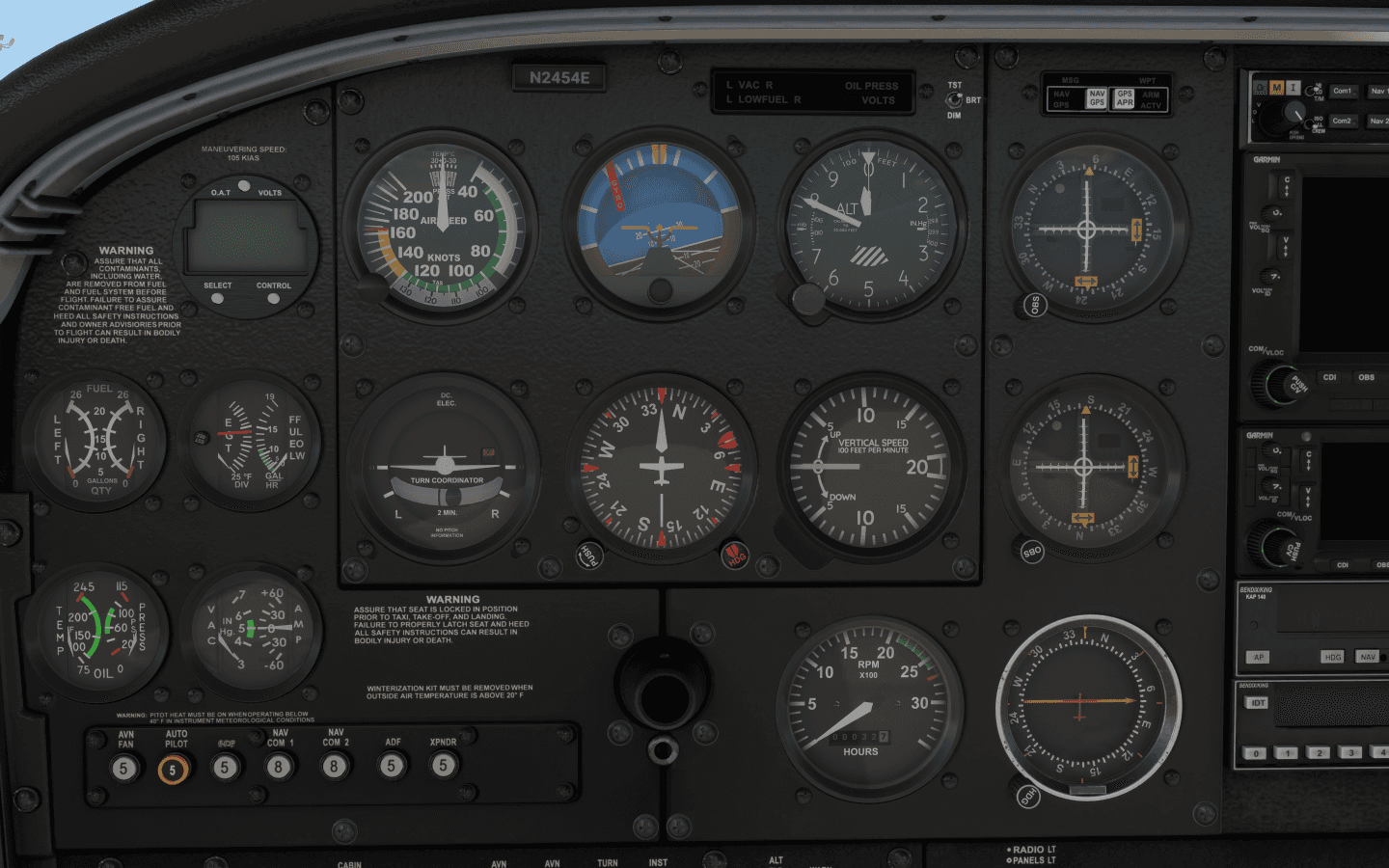
Newbie mistakes when flying for the first time under VFR
PVP seems simple - take off, fly, land. But beginners consistently make the same mistakes. We look at the top mistakes and how to avoid them the first time.
What is PVP and why is it easy to make a mistake
VFR (Visual Flight Rules, VFR) is a flight mode in which the pilot navigates visually: by the horizon, the ground, and landmarks. No need for complex FMC, no need for precise routing using NAV radio systems. This is why beginners start with PVP - it seems easy.
In fact, the absence of strict procedures relaxes, and a person makes mistakes that simply do not happen when flying under IFR (IFR).
Error 1: Ignoring the weather
VFR works only under certain weather conditions - VMC (Visual Meteorological Conditions). Minimum: horizontal visibility not less than 5 km, cloud base height not less than 300 m (depending on airspace class).
Beginners often take off “by eye” without reading METAR and TAF. The result is falling into the clouds, loss of visual orientation, panic.
Rule: before each flight - METAR of the departure and landing airfield, TAF for the coming hours. In the simulator it is especially easy to work out this with real weather.
Error 2: No height control
There is no automatic separation in PVP. The pilot himself maintains the altitude. Beginners often forget about this during navigation - they look at the map, get distracted, and the plane begins to slowly descend or climb.
In real aviation this is called CFIT (Controlled Flight Into Terrain) - collision with the ground of a controlled aircraft. One of the main causes of plane crashes in small aviation.
Rule: every 30-60 seconds - a quick glance at the altimeter and variometer. Maintain your height consciously, not passively.
Error 3: Losing spatial orientation
Beginners often cannot answer the simple question: “Where am I now?” Orientation by visual cues is a skill that needs to be practiced. The city looks like a city, a field looks like a field.
A common situation: the pilot took off, made a couple of turns and no longer understands which way the airfield is.
Rule: Before departure, study the key landmarks around the airfield - rivers, roads, cities. Use a compass and GPS as a safety net, but not as your main tool.
Error 4: Incorrect echelon selection
In PVP there is a hemisphere rule: the direction of flight determines the permissible altitude.
- Course 0–179° (east) → odd thousand feet + 500: 3500, 5500, 7500...
- Course 180–359° (west) → even thousands + 500: 4500, 6500, 8500...
Beginners do not know about this and fly at an arbitrary altitude, creating a conflict with other aircraft.
Rule: Before choosing a cruising altitude, check the heading and select the correct VFR flight level.
Error 5: Ignoring communication with the dispatcher
Many beginners think that VFR = free flight without communication. This is wrong. In controlled airspace (class C, D), communication with the controller is mandatory even for VFR.
Fear of connection is a very common problem. A person avoids radio traffic and enters an area without permission.
Rule: Learn basic phraseologies: departure request, position report, landing request. In simulators like VATSIM, this can be practiced in a safe environment.
Error 6: Incorrect fuel calculation
“I’ll get there” - classic beginner thinking. There is no FMC in PVP, which calculates fuel automatically. You need to know the consumption, distance and have a reserve.
The minimum reserve according to the rules is 45 minutes of flight for daytime VFR.
Rule: Count the fuel before departure. Route + alternate airfield + 45 minutes reserve. Always.
Error 7: Rushing during approach
Beginners go too high, too fast, and do not stabilize the decline. The result is landing at the end of the runway, go-around in panic or a hard touch.
Rule: Stabilized approach - speed, glide path and configuration are recorded no later than500 feetbefore the ground. If something is wrong, do a go-around without hesitation.
Total
PVP is freedom, but not permissiveness. Most beginner mistakes are not due to ignorance of piloting techniques, but to a lack of discipline and underestimation of basic rules. In the simulator, all these situations can and should be played out - precisely in order to act confidently in the real sky (or on a difficult route in MSFS/X-Plane).