 X-Shop Education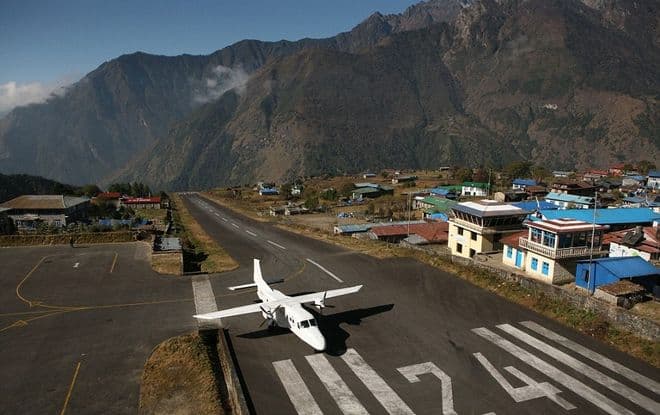
Complex landings of the world: Lukla, Gibraltar and Princess Juliana
Once you've mastered the basic piloting skills and feel confident behind the controls, it's time to try something more exciting.
Lukla, Nepal: Gateway to Everest
Why is this crazy
Tenzing-Hillary Airport in Lukla is located at an altitude of 2,845 meters in the Himalayas and has a runway just 527 meters long - about five times shorter than a normal commercial runway. Imagine a football field. Now imagine that you need to land a plane on it, traveling at a speed of 100+ km/h.
But this is just the beginning. At one end of the strip there is a sheer cliff, at the other there is an abyss into the valley. If you miss the point of contact by at least a few tens of meters, that’s it, there won’t be a second attempt. There is no missed approach procedure at Lukla. Either you sit down or you don't sit down.
Which makes it even harder
The strip has a slope of 11.7% - it literally goes up. This was done on purpose: when landing, the ascent helps the plane slow down, and when taking off, the descent gives additional acceleration. A brilliant solution, but it requires the pilot to have a perfect feel for the aircraft.
Add to this the thin mountain air, which reduces engine thrust and wing lift. At this altitude, the engines work at their limit, and the plane behaves sluggishly. If under normal conditions you are used to a certain reaction to the helm, everything will be slower and softer here.
Weather is the main enemy
In the morning the wind blows from the northeast, but by noon it changes to the southwest due to the heating of the mountains by the sun. This creates strong cross or tail winds, causing the airport to regularly close in the afternoon. During the monsoon season, up to 50% of flights are canceled due to poor visibility.
The clouds drop so low that you are literally flying blind, and then suddenly you see a mountain in front of you. Or you don’t see it - and that’s even worse.
How to train in a simulator
Start in ideal conditions - clear morning, light headwind
Use only light aircraft - Twin Otter, Pilatus PC-6. Jets don't fly here
The key to success is the correct glide path. You need to follow the visual path exactly, keeping the mountains to your left
The point of contact is critical. Try to touch the strip in the first 50 meters. If you land further than the middle, you won't have enough lane to stop.
After touching, immediately apply the brakes. No smooth braking, every meter counts here
Takeoff is a vertical climb. Immediately after takeoff, begin a sharp climb to get away from the mountains
"Expert" mode: set to fog, visibility 2-3 kilometers, crosswind 15 knots. Try to find a line in the clouds and keep the plane on the glide path. If it works, you understand what real pilots go through.
Gibraltar: where the road crosses the strip
Gibraltar Airport is the only place in the world where a main road intersects with an active runway. When the plane lands, the road is blocked by a barrier, and cars wait for the plane to pass by. Then the barrier rises and traffic resumes.
The 1,777 meter long strip runs from east to west and is used as Runway 27 or Runway 09, depending on wind direction. Sounds normal, but there's one detail: the huge 426-meter Rock of Gibraltar is right next to the strip.
The main difficulty is the wind
The airport is subject to strong crosswinds that wrap around the Rock and across the Bay of Gibraltar, making landings particularly challenging in winter. When you are about to land, the wind can suddenly change - you are flying in a straight line, but it starts to blow you sideways.
Imagine: you have aligned with the runway, are about to descend, and then a side gust blows the plane several meters to the left. You compensate, and the wind changes again. It's like trying to walk a tightrope during a storm.
Sunset from the sea
All passenger flights arrive from the east first, passing over Marbella. If the wind is from the east, you'll be faced with a spectacular maneuver: fly around the Rock from the south, turn north into Algeciras Bay, and then turn east and line up with the runway just 15 seconds from the butt.
This requires an absolute understanding of the aircraft's position in space. You fly between the mountain and the sea, constantly maneuvering, monitoring speed, altitude and at the same time preparing for landing.
Feature - no ILS
Gibraltar does not have an instrumented landing system. In poor visibility, controllers guide the aircraft using radar until the final stage of approach. At a distance of 5 kilometers from the runway, the pilot must see it visually. If he doesn’t see it, he goes to the reserve (usually Malaga).
This means that in the simulator you need to learn to fly, relying on control commands and your eyes, and not on automation.
How to train
Study the topography. Open a satellite map and see how the Rock is located relative to the strip
Train for cross winds. Set the wind to 20-25 knots at a 45° angle to the runway
Practice the approach with a turn. Approach Runway 09 from the east, fly around the Rock and level off
Learn to “feel” the demolition. Crosswinds will constantly blow you off course - you need to learn to compensate for this with roll and yaw
Crosswind landing is an art in itself. The nose of the plane should point slightly towards the wind to compensate for drift.
Tip: If you want to get a feel for the place, take a couple of low-altitude flights along the runway. Look how close the Rock is, how narrow the space for maneuver is. This will help you understand why Gibraltar is considered one of the most difficult airports in Europe.
Princess Juliana, St. Maarten: low sunset over the beach
What does everyone know about it?
This airport is a YouTube and Instagram star. The strip is located a few tens of meters from Maho beach, and planes land directly above the heads of vacationers. People stand on the beach, hold on to the fence, and film on their phones as a Boeing 737 or Airbus A320 passes 10-15 meters above them.
The 2,300-meter runway appears sufficient for medium-haul aircraft, but its proximity to water and mountains poses unique challenges.
The main difficulty is the illusion of height
The approach to Runway 10 is over water, which can disorient pilots regarding altitude when flying according to visual rules. There are no usual landmarks above the water - trees, buildings, cars. The surface of the ocean deceives perception, and it seems to you that you are higher or lower than you really are.
If you go too low, there is a risk of touching the water before the strip. Too high and you'll fly over the runway and won't have time to brake. In 2017, it was here that a tragic incident occurred: a jet stream from a taking off plane hit a tourist standing at the fence, which led to her death.
Takeoff is no easier than landing
After takeoff, you must immediately turn right to avoid the mountains directly ahead. This is not a recommendation - it is a requirement. If you continue the straight climb, in a few seconds you will find yourself face to face with a mountainside.
Imagine: you have just taken off from the ground, the speed has not yet been gained, the plane is heavy, and you already need to start a coordinated turn. Any mistake in technique and you will either lose height or not have time to dodge.
Psychological factor
When you are landing over the beach at an altitude of 15-20 meters, instinct screams at you: “You are too low! Pull the yoke!” But if you listen to this instinct, you will fly over the runway and not have time to land. You need to trust devices, not feelings.
Experienced pilots call this approach exciting - you literally glide over a strip of beach before touching down on the strip.
How to train
Set the starting point for the final approach over the water, 7-8 kilometers from the runway at an altitude of 600 meters
Watch the devices, not the view. Your eyes will deceive you, saying that you are too low
Maintain glide path at 3°. Use a vertical speed of about 500-700 feet per minute
Don't pull the helm over the beach. This is the most difficult thing - to suppress the instinct and continue to decline
After touching, immediately turn around. As soon as the wheels leave the ground, begin a smooth turn to the right.
Extra challenge: try taking off on a heavy aircraft (full tank, full load). You will feel how slowly you gain speed and altitude, and how little time you have to reach the mountains.
Tips for all three airports
Watch real videos. There are thousands of videos on YouTube with real landings at these airports. Watch how the pilots behave, how they maintain the glide path when they begin maneuvers.
Use appearance. In the simulator, you can switch to an external camera and see what your approach looks like from the outside. This helps to understand errors.
Start with a passenger plane. These landings are easier to do on smaller planes. Try the Boeing 737 or Airbus A320 first - they have more automation that will back you up.
Accept mistakes. You will crash. Many times. In Lukla you will fly into the abyss. In Gibraltar you will be blown out to sea. In St. Maarten you will splash down in front of the runway. This is fine. Every disaster is a lesson.
Study the procedures. Each of these airports has specific entry procedures. Find them on the Internet, study them, practice using the checklist.
Why is this necessary?
These airports are not just difficult - they teach you how to read the weather, feel the plane, and make decisions in a second. After Lukla, a regular landing at Domodedovo will seem like child's play. After Gibraltar you will no longer be afraid of side winds. After Princess Juliana, you will learn to trust instruments more than your eyes.
It's not just achievements in the simulator - it's the skills that make you a real pilot. Let it be virtual.
Are you ready? Fasten your seat belts, retract the flaps and begin your descent. The most exciting flights of your life are ahead.